CHI Fellowship 2025–2026
About the Project
A digital humanities research project mapping cinematic resistance in Palestinian women's filmmaking.
Cinematic Counter-Cartographies
This project maps how Palestinian women filmmakers, principally Mai Masri, Annemarie Jacir, and Farah Nabulsi, create counter-cartographies through their cinematic treatment of Israeli checkpoints and surveillance infrastructure. Drawing on films released between 2000 and 2025, it argues that film and literature function as complementary counter-cartographic methods: while film captures the materiality of carceral space through architecture, movement, framing, and sound design, literature maps what surveillance cannot document, which is the interior consciousness, embodied memory, and emotional labor that sustain Palestinian life under occupation.
Central to the project is the concept of sumud, Palestinian steadfastness and creative persistence, as both a lived philosophy and an analytical framework. The digital archive tracks how sumud operates not as passive endurance but as active spatial, temporal, and cinematic refusal.
Methodologically, this is a digital humanities project that combines close formal analysis of film and literary texts with counter-cartographic spatial theory. Each checkpoint functions as a case study: a site that can be mapped geographically, traced across the film archive, and analyzed for how different directors film the same space differently over time. The digital format allows those three registers such as geography, archive, and analysis to exist in conversation rather than in sequence.
Scholarly Foundations
Counter-Cartography and the Production of Space
Henri Lefebvre's challenge to move beyond static definitions of space, to see it as a contested product of social relations and power, is foundational here. Palestinian artists are not only contesting space but creating new imaginaries and alternative forms of spatial knowledge that surveillance infrastructures cannot capture. De Certeau's complementary formulation that "what the map cuts up, the story cuts across" positions Palestinian film and literature as acts of spatial refusal: by refusing the spatial logics imposed by occupation, these artists narrate space differently, and the act of re-narration becomes a form of political resistance. Eyal Weizman's concept of the "politics of verticality" in Hollow Land extends this framework materially, theorizing how Israeli control operates three-dimensionally through checkpoint infrastructure, settlement patterns, and aerial surveillance.
Surveillance, Race, and the Gendered Gaze
Simone Browne's Dark Matters provides the critical lens for understanding how surveillance is always racialized and always gendered, operating differently on different bodies and creating blind spots precisely through those differences. Palestinians do not experience surveillance uniformly: their racialization under occupation produces different levels of scrutiny and forms of vulnerability, and these asymmetries are precisely what Palestinian women filmmakers make visible. Julie Peteet's Space and Mobility in Palestine centers the everyday Palestinian body, showing how the permit system, road closures, and checkpoints are designed to control Palestinian mobility, and through that control, Palestinian life. Peteet's concept of "carceral time", time weaponized through delay, is particularly important for understanding how Palestinian cinema uses duration as a formal argument.
Sumud: Steadfastness as Analytical Framework
Lena Meari's theorization of sumud is central to this project. For Meari, sumud is not passive endurance but active political confrontation, a "political being/becoming and continuous engagement with the flows and constraints of the colonial situation." Jane Busse advances this through her concept of "sumud as a spatial quotidian practice," showing how Palestinians generate alternative spatial knowledge simply by living and creating within occupied space. Saleem Haddad's three-part understanding of sumud, as record-keeping and revitalization, as bearing witness and collective memory, and as a radical and daring act of imagination, organizes the project's analytical framework. Palestinian women filmmakers do all three things simultaneously: they preserve, they witness, and they imagine.
Feminist Witnessing
Maria Lugones' concept of faithful witnessing frames this project's feminist methodology. To witness faithfully is an active political commitment: standing with oppressed people against powerful institutions, recognizing resistance even when it goes against the grain of dominant common sense, and refusing the narrow worldview that siding with oppression demands. Yomaira Figueroa-Vásquez extends Lugones' thinking by showing how cultural production not only represents faithful witnessing but performs it, literature and film becoming sites where artists build counter-archival records that dominant systems are not structured to recognize. Nadera Shalhoub-Kevorkian's concept of "infiltrated intimacies" shifts the focus from visible militarized spaces into the deeply private zones of Palestinian women's lives, showing how occupation shapes daily routines, relationships, safety, and reproductive decisions. Because women inhabit these intimate spaces, they can witness from the inside, capturing forms of knowledge that neither counter-cartography nor the checkpoint camera can hold.
What This Research Asks
- How do camera angles refuse the surveillance gaze?
- What do ellipses and offscreen space keep from view - and why does that matter politically?
- How does editing create a counternarrative to security footage?
- What is the politics of what these filmmakers choose not to show?
- How does feminist witnessing of carceral space prompt the imagination of Palestinian futures?
Fellowship Details
Project Info
Theoretical Frameworks
Works Cited
Books
Browne, Simone. Dark Matters: On the Surveillance of Blackness. Duke University Press, 2015.
De Certeau, Michel, et al. Practice of Everyday Life: Volume 2: Living and Cooking. Edited by Luce Giard, University of Minnesota Press, 1998. JSTOR, http://www.jstor.org/stable/10.5749/j.ctt5vkbhw. Accessed 1 Nov. 2025.
Demos, T.J. The Migrant Image: The Art and Politics of Documentary during Global Crisis. Duke University Press, 2013.
Gertz, Nurith, and George Khleifi. Palestinian Cinema: Landscape, Trauma, and Memory. Indiana University Press, 2008.
Gilmore, Ruth Wilson. Golden Gulag: Prisons, Surplus, Crisis, and Opposition in Globalizing California. University of California Press, 2007.
Halasa, Malu, Jordan Elgrably, and Saleem Haddad. Sumūd: Essays, memoir, fiction, poetry, and art from the Markaz Review: A new Palestinian reader. Seven Stories Press, 2025.
Lefebvre, Henri. The Production of Space. Translated by Donald Nicholson-Smith, Blackwell, 1991.
Lugones, María. Pilgrimages/Peregrinajes: Theorizing Coalition Against Multiple Oppressions. Rowman & Littlefield, 2003.
Noble, Safiya Umoja. Algorithms of Oppression: How Search Engines Reinforce Racism. New York University Press, 2018.
Peteet, Julie. Space and Mobility in Palestine. Indiana University Press, 2017.
Vizenor, Gerald. Survivance: Narratives of Native Presence. University of Nebraska Press, 2008.
Weizman, Eyal. Hollow Land: Israel’s Architecture of Occupation. Verso, 2007.
Journal Articles and Book Chapters
Busse, Jane. “Everyday Life in the Face of Conflict: Sumud as a Spatial Quotidian Practice in Palestine.” Political Geography, vol. 66, 2022, pp. 102–13.
Figueroa, Yomaira C. “Faithful Witnessing as Practice: Decolonial Readings of ‘Shadows of Your Black Memory’ and ‘The Brief Wondrous Life of Oscar Wao.’” Hypatia, vol. 30, no. 4, 2015, pp. 641–56. JSTOR, http://www.jstor.org/stable/24541973. Accessed 1 Nov. 2025.
Kotef, Hagar, and Merav Amir. “(En)Gendering Checkpoints: Checkpoint Watch and the Repercussions of Intervention.” Signs: Journal of Women in Culture and Society, vol. 32, no. 4, 2007, pp. 973–96.
Meari, Lena. “Sumud: A Palestinian Philosophy of Confrontation in Colonial Prisons.” South Atlantic Quarterly, vol. 113, no. 3, 2014, pp. 547–78.
Shalhoub-Kevorkian, Nadera. “Infiltrated Intimacies: The Case of Palestinian Returnees.” Surveillance & Society, vol. 14, no. 3–4, 2016, pp. 456–70.
Tawil-Souri, Helga. “Digital Occupation: Gaza’s High-Tech Enclosure.” Journal of Palestine Studies, vol. 41, no. 2, 2012, pp. 27–43.
———. “Qalandia Checkpoint: The Historical Geography of a Non-Place.” Jerusalem Quarterly, no. 42, 2010, pp. 26–48.
Primary Texts
The Present. Directed by Farah Nabulsi, Netflix, 2020.
Salt of This Sea. Directed by Annemarie Jacir, Rotana Studios, 2008.
Shibli, Adania. Minor Detail. Translated by Elisabeth Jaquette, New Directions, 2020.
The Teacher. Directed by Farah Nabulsi, Front Row Filmed Entertainment, 2023.
Ayaat Ismail
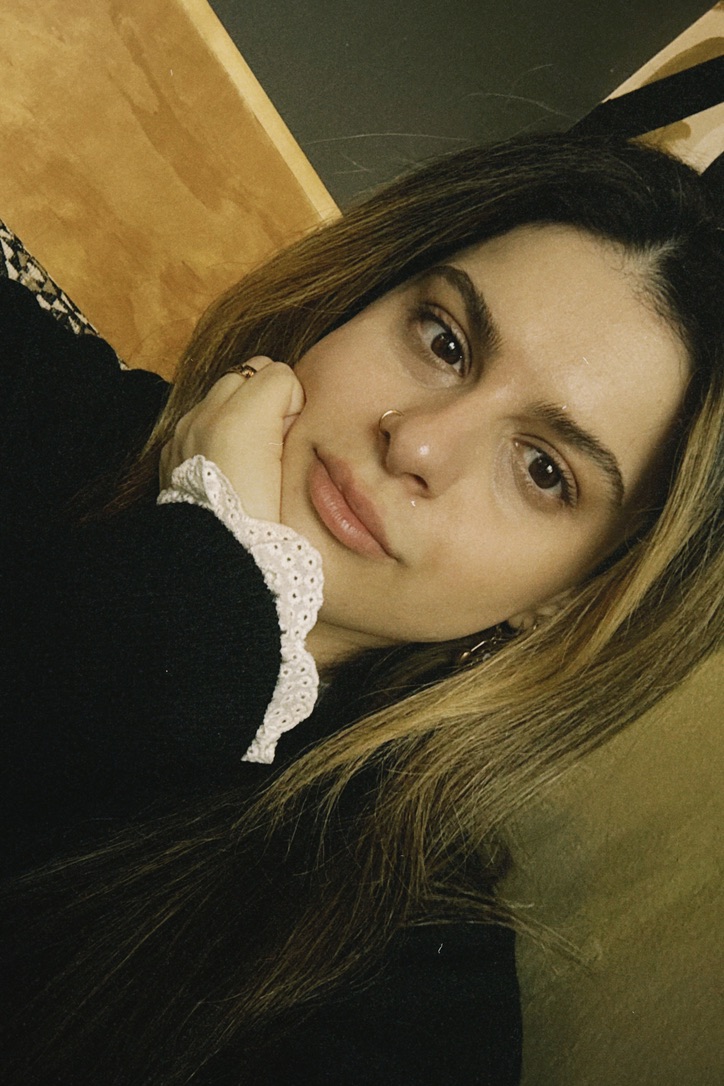
I am a PhD student and CHI Fellow at Michigan State University, specializing in Women and Gender Studies and working at the intersection of digital humanities, Palestinian film studies, and feminist surveillance theory. I also hold certificates in Film Studies, Global Studies, and Digital Humanities. My research centers on Palestinian women filmmakers and the formal strategies through which cinema refuses, rather than simply documents, occupation. I am particularly interested in what feminist witnessing makes legible that conventional archives cannot hold.
Cinematic Counter-Cartographies is my most recent and major digital project, an attempt to do scholarship in a form that matches my core argument: that space, story, and resistance cannot be separated. Through this work, I aim to show how digital humanities can illuminate the creative and political strategies of Palestinian women filmmakers, making visible the forms of knowledge and resistance that often remain outside traditional archives.
- Certificates: Film Studies, Global Studies, Digital Humanities
- Specialization: Women and Gender Studies